
In Albonair’s documented air-assisted architecture, compressed air helps atomize DEF at an external-mixing nozzle. The dosing unit and nozzle are distinct components. Identify the product family before using this description: Albonair also offers a Compact Dosing System that requires no compressed air. Albonair products · Compact Dosing System brochure, p.2
This guide explains the operating principle and the information needed for a useful service or parts enquiry. It does not provide a universal hose diagram, pressure setting or vehicle fitment list.
1. Follow two media to one mixing point
Albonair describes separate passages for air and DEF, with mixing at the nozzle outlet. In the air-assisted family, the dosing unit meters the reductant and compressed air supports spray formation. Original product description
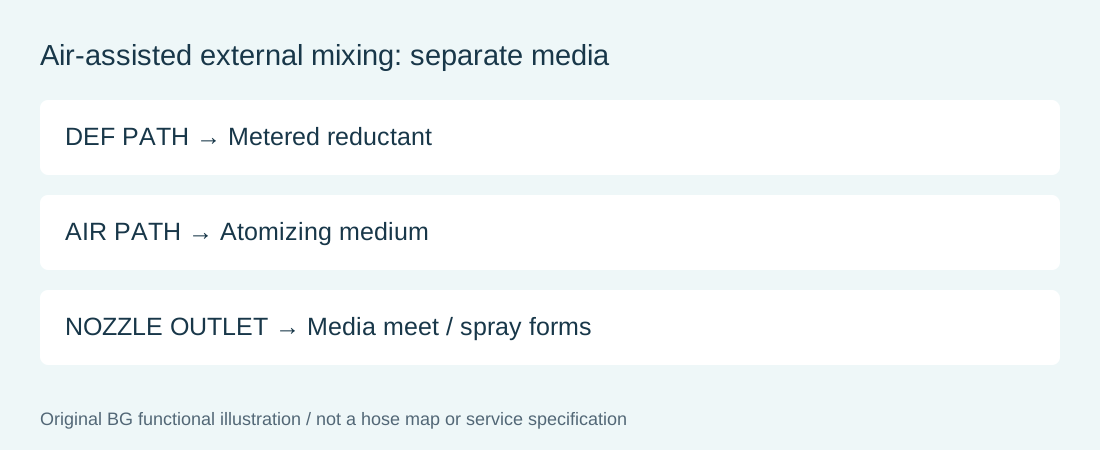
The practical implication is that liquid delivery and atomization are different questions. Evidence that DEF reaches a component does not establish that the installed air path is functioning correctly. Conversely, an available compressed-air supply does not establish correct liquid metering. Record both observations under the conditions prescribed by the vehicle procedure.
2. Keep component roles separate
The manufacturer describes the conventional nozzle as having no moving parts or sensors and requiring no active cooling. Its dosing units can be controlled by Albonair’s controller or a customer controller; engine cooling water provides frost heating at the dosing unit. These statements describe the referenced product family rather than every subsequent Albonair design. Albonair dosing-unit and nozzle sections
| Item | Question it helps answer | What must still be confirmed |
|---|---|---|
| Dosing unit | Where is metering managed? | Installed assembly and control configuration |
| Compressed-air path | Is the atomizing medium available as required? | Correct routing and prescribed test conditions |
| DEF path | Is liquid delivered as required? | Fluid condition, routing and measured delivery |
| Nozzle | Where do the two media meet? | Exact nozzle variant and installation |
| Controller | Which commands and diagnostics apply? | Vehicle-specific documentation and software |
A diagnostic label translated as “injector” may refer to a system function rather than an electrical valve inside the nozzle. Before testing a circuit or ordering a nozzle, identify the actual component named by the code and wiring diagram. Do not transfer another supplier’s injector pinout, resistance value or cooling test to this system.
3. Why an air-side check belongs in the fault report
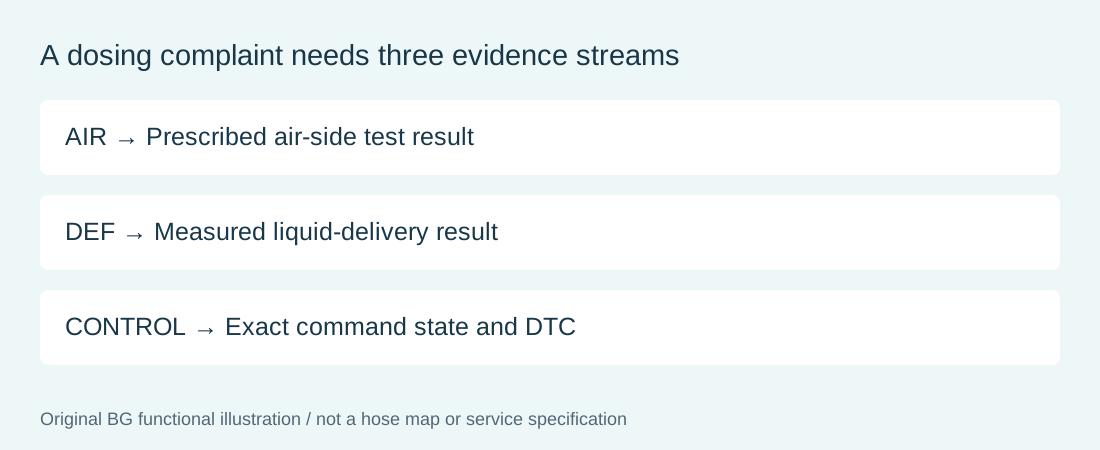
The following is an engineering evidence checklist, not a list of measured Albonair failure rates. Apply the relevant manufacturer procedure rather than improvised adjustments.
| Observation | Evidence to preserve |
|---|---|
| Poor or absent dosing | Exact DTC, command state, liquid-delivery result and air-side test result |
| Deposits near injection | Deposit location, leakage evidence and nozzle assessment |
| Suspected air restriction | Installed routing and the specified pressure/flow test, with its conditions |
| Cold-weather complaint | Identified heating circuit and documented thawing checks |
| Electrical warning | Component identity, circuit definition and connector photographs |
| Repeat replacement request | Original references and previous verified findings |
Do not treat pump sound as a delivery measurement, or a visible deposit as proof of a particular failed assembly. A fault report should distinguish observation from diagnosis. This article sets no universal air-pressure limit, dose quantity, purge interval or electrical acceptance value.
4. Where the air-assisted description stops
The separate Compact Dosing System brochure explicitly identifies a design that does not need compressed air. That product-specific statement limits the scope of broader website descriptions of air-assisted dosing. It is therefore inaccurate to classify every Albonair product by a single air-assisted architecture. Compact Dosing System brochure, p.2
Likewise, heated nozzles, dual dosing and stationary installations require their own product documentation. A supplier name does not establish an identical metering arrangement, wiring diagram or shutdown sequence. Identify the installed product before choosing tests.
5. Supplier application evidence is not a vehicle matrix
Albonair names Volvo, Renault and Liebherr as customer examples. That supports supplier-level context, not a complete engine, model-year or VIN fitment table. Manufacturer product overview
For a parts match, preserve the full installed number, every prefix and suffix, connector photographs, supply voltage, vehicle/engine identity and emission configuration. A connector count or similar housing can narrow a search; neither approves an interchange. Where an OE cross-reference is proposed, check it against authoritative application or supersession information before supply.
6. A genuine BG reference for an enquiry
BG lists BG203200 / OE 7422039620 as an aftermarket urea pump assembly. This is a real product-page link and catalogue photograph. It is a reference for an enquiry, not an independently verified declaration that every Volvo or Renault installation uses the same Albonair unit. BG203200 product page

The article does not adopt the product page’s generic internal-component description or treat its complete cross-reference list as verified OEM supersession evidence. Submit the original label and connector photographs with the enquiry rather than selecting solely from a vehicle-family name.
Quick answers
Does Albonair always mean air-assisted? No. The Compact Dosing System is explicitly described as requiring no compressed air. Identify the branch first.
Can a liquid-side result prove good atomization? It leaves the air-side evidence unresolved in an air-assisted installation. Compare both with the correct service procedure.
Can this guide identify a replacement by vehicle model alone? No. It explains architecture and evidence boundaries; the installed reference and vehicle-specific application data remain necessary.
Sources and related reading
- Albonair: Products — manufacturer description of dosing units, external-mixing nozzles and customer examples; checked 2 November 2026.
- Albonair: Compact Dosing System brochure — p.2 establishes the separate no-compressed-air branch; checked 2 November 2026.
- BG203200 product catalogue — used for the catalogue reference, photograph and enquiry link; not an OEM service source.
- Commercial-vehicle SCR dosing systems — published series overview.