
Key distinction
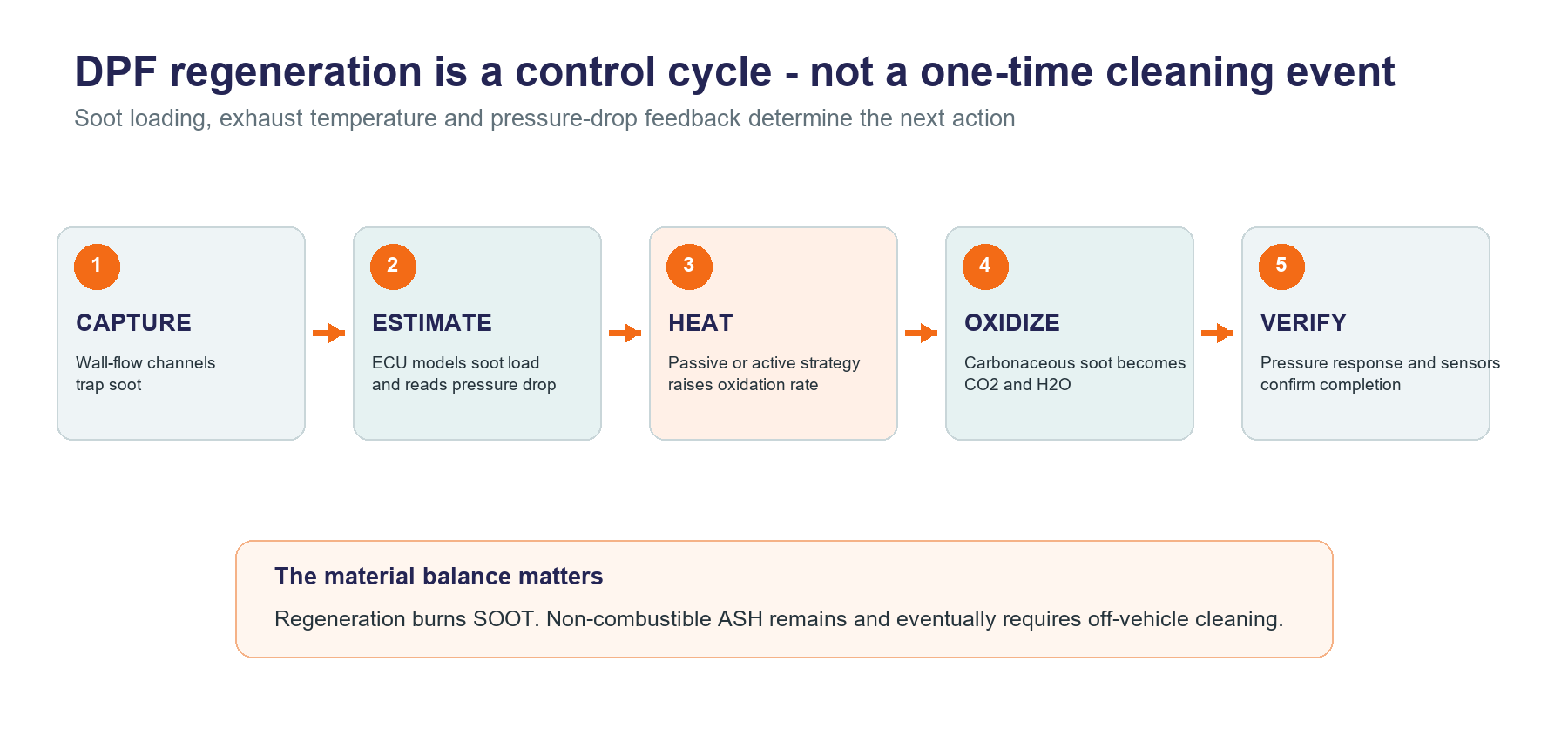
Regeneration oxidizes combustible soot. It does not make non-combustible ash disappear. A filter that repeatedly requests regeneration may need diagnosis, ash removal or replacement — not another blind forced-regen command.
What a DPF actually captures
A wall-flow diesel particulate filter forces exhaust gas through porous ceramic channel walls. Solid particles are retained while cleaned gas exits through adjacent channels. This structure can remove a very high proportion of particulate matter, but the trapped material increases flow resistance and exhaust backpressure.
The control system therefore estimates DPF loading using a combination of differential pressure, exhaust gas temperature, engine operating data and a calculated soot model. When the required conditions are available, the system oxidizes the carbon-rich soot and restores soot-storage capacity.
Four regeneration methods — and their correct use
Passive regeneration
Occurs during normal sustained-load operation when exhaust temperature and NO₂ availability are sufficient to oxidize soot without a separate ECU heating event. Highway operation is favorable; repeated short, cold trips are not.
Active regeneration
The ECU raises DPF temperature through application-specific strategies such as post-injection, intake throttling, an exhaust fuel doser or other thermal-management controls. EGT feedback prevents overheating and verifies the event.
Forced or service regeneration
A diagnostic tool commands a stationary or controlled regeneration after the technician confirms that oil level, fuel system, temperatures, pressure signals and substrate loading are within safe limits. It is a procedure, not a universal cure.
Off-vehicle thermal regeneration
The removed DOC, DPF or SCR ceramic substrate is processed in a controlled oven. Multi-stage heating can oxidize remaining carbonaceous deposits evenly; an approved pneumatic or wet step may still be required to remove residual ash.
Soot and ash are not the same maintenance problem
Soot is largely carbonaceous and can be oxidized when the filter reaches the required temperature in a controlled oxygen environment. Ash contains non-combustible material, primarily derived from lubricant additives, trace fuel constituents, wear and corrosion products. Every successful soot regeneration leaves this inorganic fraction behind.
As ash fills the channels, effective filter volume falls and pressure drop can rise. The ECU may request regeneration more frequently even though the underlying restriction is no longer mainly soot. This is why regeneration history, pressure response, service interval and physical inspection must be interpreted together.
Why DPF regeneration fails
| Failure pattern | Possible causes | Evidence to check | Common mistake |
|---|---|---|---|
| Regen aborts or never starts | Low exhaust temperature, insufficient fuel, active engine fault, implausible EGT or pressure input | Enable criteria, live EGT, differential pressure, fuel level and freeze-frame data | Replacing the DPF before checking why the ECU blocked regeneration |
| Regen occurs too frequently | High engine-out soot, excessive ash, biased pressure reading, leaking injector, poor duty cycle | Oil consumption, injector balance, pressure hoses, calculated soot/ash history | Repeating forced regeneration without correcting the engine cause |
| High pressure remains after regen | Ash loading, melted/cracked substrate, blocked pressure tubes, incomplete regeneration | Cold and hot flow/pressure test, filter mass, borescope inspection, sensor-hose integrity | Assuming pressure drop alone proves that all ash was removed |
| Over-temperature event | Excessive soot load, uncontrolled fuel, biased EGT, uneven deposit distribution | Pre-service soot estimate, EGT correlation, oil/fuel contamination and substrate inspection | Commanding a stationary regen on an unknown or unsafe soot load |
| DPF fault returns after replacement | Root engine fault, exhaust leak, sensor or wiring fault, software/adaptation issue | Upstream engine condition, leak test, sensor plausibility and post-repair monitor | Treating the filter as the cause rather than the result |
Scroll horizontally to see all columns.
A safe professional diagnostic sequence
- 1
Preserve the evidence. Record active, pending and history codes plus freeze-frame and regeneration history before clearing anything.
- 2
Check the engine first. Diagnose oil consumption, boost/EGR faults, poor combustion, injector problems and coolant or fuel contamination that can overload the filter.
- 3
Validate the sensors. Inspect differential-pressure pipes, wiring and connectors; compare pressure response with airflow and correlate all EGT sensors from cold start through load.
- 4
Assess regeneration safety. Confirm soot estimate, filter integrity, exhaust leaks, fluid levels and the manufacturer's stationary-regeneration limits.
- 5
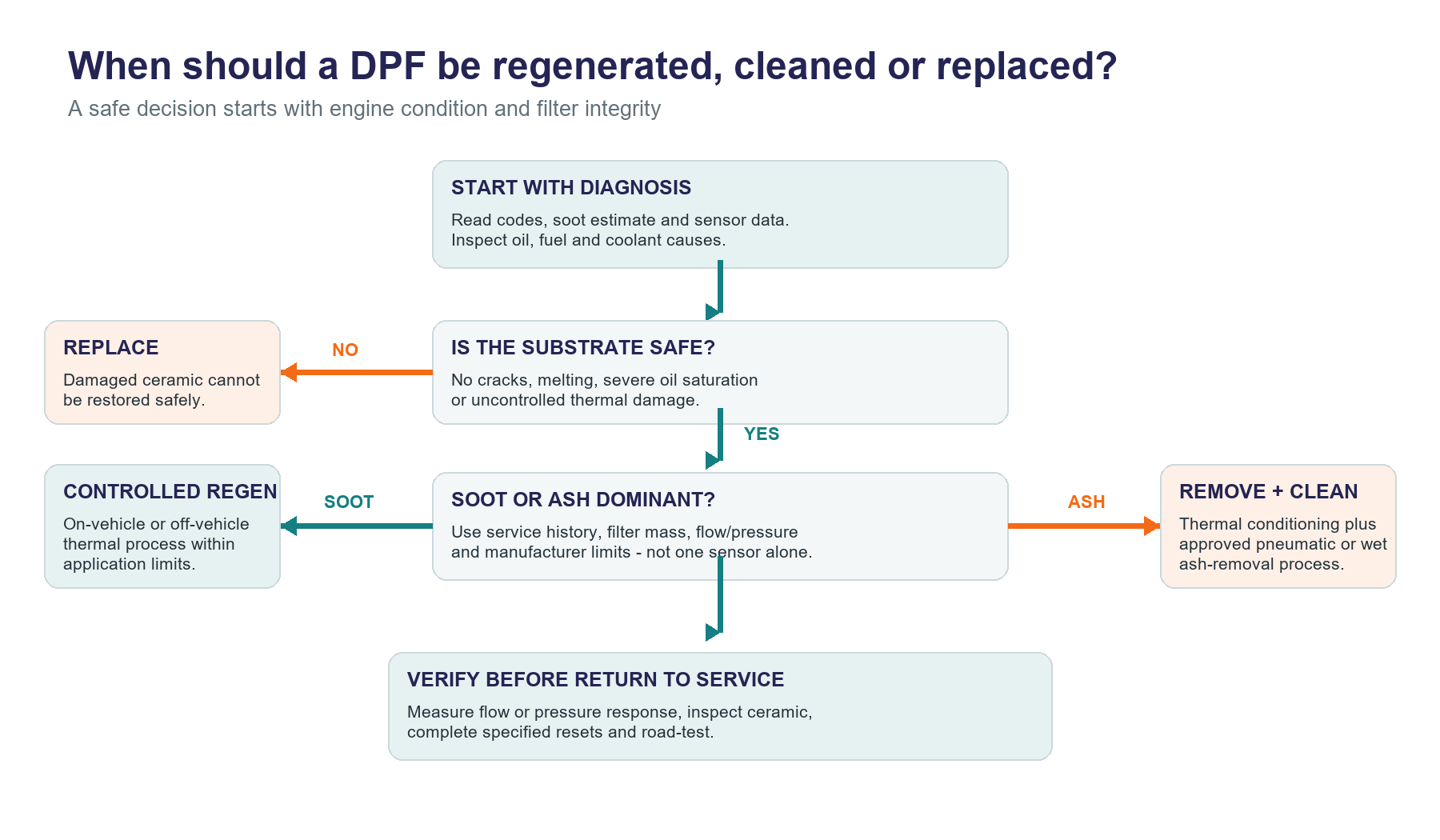
Select the process. Use passive/active operation for normal soot control, forced regeneration for a safe service event, off-vehicle thermal conditioning plus ash removal for maintenance, or replacement for damaged substrates.
- 6
Verify the outcome. Inspect the filter, measure post-process restriction or flow, complete required resets/adaptations and confirm the monitor during a controlled road or load test.
BG high-temperature regeneration equipment
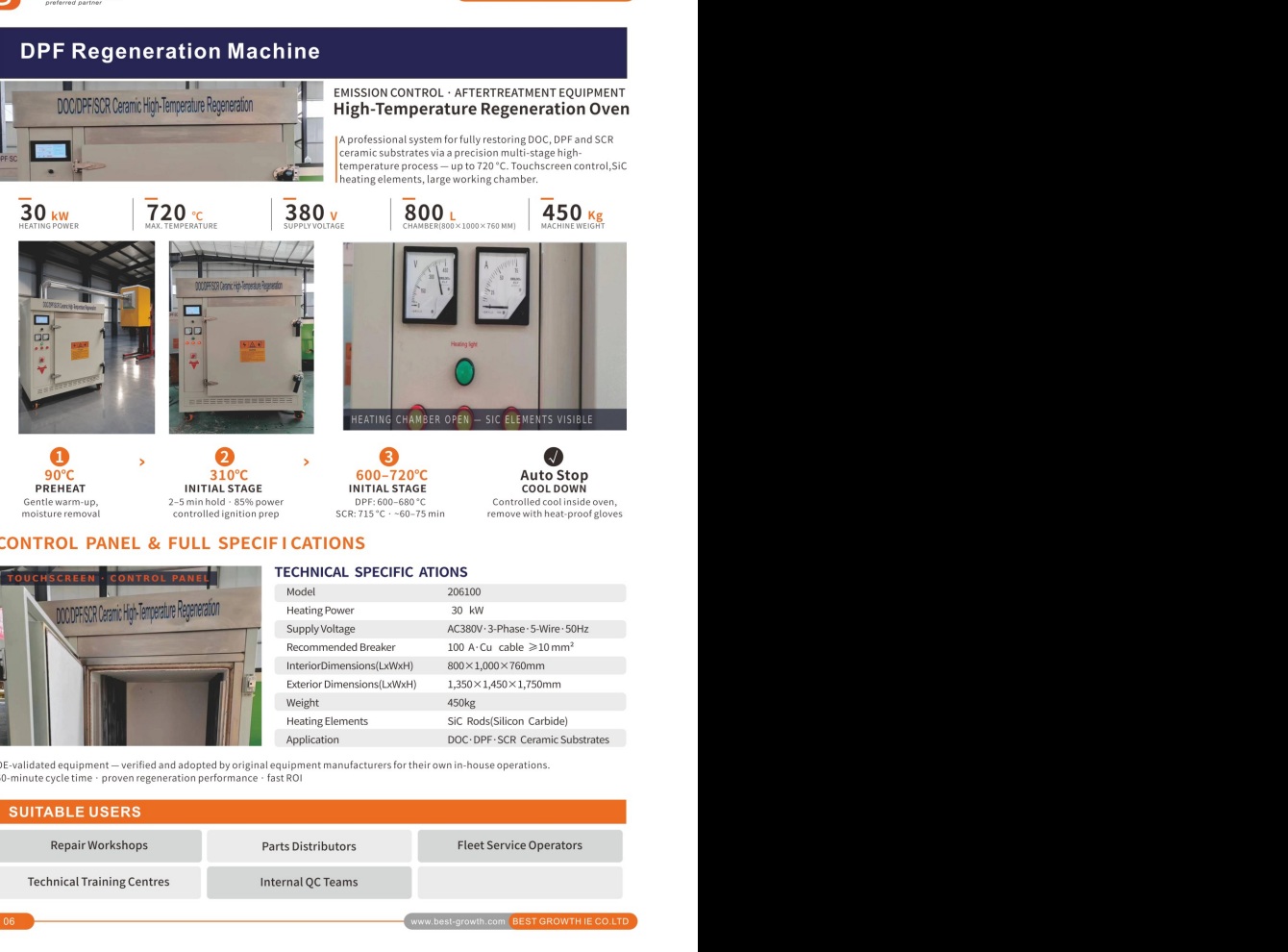
For workshops, parts distributors, fleet service operators, technical training centers and internal quality teams, BG offers a professional high-temperature regeneration oven for removed DOC, DPF and SCR ceramic substrates. The system uses a controlled, multi-stage heating profile rather than an uncontrolled heat shock.
BG Model 206100 — key specifications
Recommended process: gentle 90°C preheat, an approximately 310°C initial stage, controlled 600–720°C regeneration and automatic cool-down. Silicon-carbide heating elements and touchscreen control support repeatable thermal processing.
The regeneration oven addresses thermal processing. Ash-removal method, acceptance criteria and maximum permissible temperature must follow the substrate or equipment manufacturer’s instructions. Do not process cracked, melted or severely oil-saturated filters without a documented safe procedure.
Frequently asked questions
+What is DPF regeneration?
DPF regeneration is the controlled oxidation of carbonaceous soot trapped in the filter. It reduces soot loading and exhaust restriction but leaves non-combustible ash behind.
+What is the difference between passive and active DPF regeneration?
Passive regeneration uses naturally available exhaust heat during normal duty. Active regeneration is commanded by the ECU and adds heat through calibrated engine or aftertreatment strategies.
+Does forced regeneration remove ash?
No. A forced regeneration can burn soot when conditions are safe. Inorganic ash requires an approved off-vehicle cleaning process.
+Can a blocked DPF always be regenerated?
No. Regeneration is unsafe or ineffective when the substrate is cracked, melted, severely contaminated, overloaded beyond the approved limit or restricted mainly by ash. Diagnosis determines whether to regenerate, clean or replace.
+Why does the DPF light return after regeneration?
The root cause may still be present: low-temperature duty, biased sensors, pressure-hose blockage, excessive oil consumption, injector faults, exhaust leaks, ash accumulation or damaged ceramic.
+How hot does DPF regeneration get?
The correct range depends on the substrate, catalyst, loading and manufacturer strategy. Vehicle regeneration commonly requires elevated exhaust temperatures, while professional off-vehicle ovens use a controlled application-specific profile. Never apply a universal temperature without confirming the component limit.
Need DPF regeneration equipment or aftertreatment diagnostic support?
Send BG the application, substrate dimensions, equipment voltage/frequency, expected daily throughput and intended cleaning workflow. The BG team can help confirm equipment suitability and related DPF, EGT, PM, NOx and dosing-system service requirements.
Contact the BG technical teamRelated pages
Technical basis: BG product literature for Model 206100; U.S. EPA guidance on DPF operation, regeneration and ash maintenance; application-specific service information remains the final authority. AdBlue® is a registered trademark of the VDA. Vehicle and equipment manufacturer names are used only for identification and compatibility reference.